Aviation News
-
A U.S. Air Force F-35A Lightning II, assigned to the Vermont Air National Guard, prepares to land at the Burlington International Airport, South Burlington, Vermont, April 21, 2026. The jets flew a routine training mission to ensure operational proficiency. (U.S. Air National Guard photo by Airman 1st Class Raymond LaChance)

An F/A-18E Super Hornet, assigned to Strike Fighter Squadron (VFA) 25, lands on the flight deck of the Nimitz-class aircraft carrier USS Theodore Roosevelt (CVN 71), April 18, 2026. VFA 25, part of Carrier Air Wing 11 and the Theodore Roosevelt Carrier Strike Group, is operating in the U.S. 3rd Fleet area of operation conducting advanced training to bolster strike group readiness and capability. (U.S. Navy photo by Mass Communication Specialist Seaman Tyler Harstad)
An F/A-18F Super Hornet, assigned to Strike Fighter Squadron (VFA) 154, lands on the flight deck of the Nimitz-class aircraft carrier USS Theodore Roosevelt (CVN 71), April 18, 2026. VFA 154, part of Carrier Air Wing 11 and the Theodore Roosevelt Carrier Strike Group, is operating in the U.S. 3rd Fleet area of operation conducting advanced training to bolster strike group readiness and capability. (U.S. Navy photo by Mass Communication Specialist Seaman Tyler Harstad)
U.S. Air Force Airmen assigned to the 95th Fighter Generation Squadron prepare F-35A Lightning II aircraft for flight operations during Exercise Ready Tiger 26-3 at Savannah Air National Guard Base, Georgia, April 15, 2026. Crew chiefs ensured the aircraft was safe, properly configured and ready for flight, playing a critical role in mission success. Airmen demonstrated disciplined execution and accountability, key to maintaining Air Force standards and readiness. (U.S. Air Force photo by Senior Airman Victoria Moehlman)
SYRACUSE, N.Y., April 21, 2026 — Lockheed Martin (NYSE: LMT), in collaboration with Northrop Grumman, has successfully completed flight testing of the Digital Receiver Exciter Recorder (DREXR) upgrade for the U.S. Navy’s E-2D Advanced Hawkeye aircraft.
The successful tests strengthen the Navy’s ability to detect, track and counter evolving threats in contested and austere environments, reinforcing the E-2D’s critical role in defending the Carrier Strike Group. The upgrade enhances commanders’ situational awareness and decision-making speed, providing a decisive operational advantage across the battlespace.
“The successful DREXR flight tests demonstrate our commitment to keeping the E-2D Advanced Hawkeye at the forefront of airborne early warning and battle management,” said Rick Cordaro, vice president of Lockheed Martin Radar and Sensor Systems. “By modernizing this proven platform, we are ensuring it remains a critical enabler for force protection, command and control, and mission success in today’s increasingly complex threat environment.”
DREXR is a compact, single-box upgrade, replacing the current Exciter and Receiver subsystems, that delivers next-generation radar performance while extending the operational life of the Navy’s premier airborne early warning platform. During flight testing, the joint industry team validated key capabilities, including wideband transmit and receive, independent transmit per radar element, and software-defined waveform functionality. The team also collected critical radar data through the integrated recorder to support mission analysis and ongoing advanced capability development, including artificial intelligence.
About the E-2D Advanced Hawkeye
The E-2D Advanced Hawkeye is the world’s most proven airborne early warning and battle management platform, connecting air, sea and joint forces into a single operational network. Its APY-9 radar, mission computer and integrated sensor suite enable multi-domain, multi-mission operations from both land and sea. Continuous modernization ensures the platform delivers day-one interoperability, operational resilience, and sustained mission readiness to deter and defeat advanced threats.
WASHINGTON, April 20, 2026 /PRNewswire(opens in a new tab)/ -- Boeing [NYSE: BA] and Ethiopian Airlines announced today the purchase of six 787 Dreamliner jets as the airline fully exercises commitments from its 2023 landmark order(opens in a new tab). Ethiopian Airlines will use the 787-9 jets to expand its intercontinental network from Addis Ababa and increase cargo capacity as demand for long-haul travel continues to rise.
"Converting the options of six Boeing 787-9 Dreamliner airplanes into a firm order is truly a proud moment for us," said Ethiopian Airlines Group CEO, Mr. Mesfin Tasew. "The order shows Ethiopian Airlines' sustainable growth and preparation for further achievements. By growing our fleet size with ultra-modern airplanes such as the Boeing 787-9 Dreamliner, we are further maintaining operational excellence and passengers' comfort."
Ethiopian Airlines operates Africa's largest 787 Dreamliner fleet, flying its 787-8 and 787-9 jets on intercontinental routes from Addis Ababa to high-demand destinations across Europe, Asia and North America as well as key intra-African routes spanning the world's second-largest continent.
"We're proud that Ethiopian Airlines continues to look to the 787 Dreamliner to serve as the backbone of their fleet as they grow and modernize their operations, open new routes and comfortably serve more passengers," said Anbessie Yitbarek, Boeing vice president of Commercial Sales and Marketing for Africa.
The 787 Dreamliner's versatility and reduced fuel use enable Ethiopian Airlines to efficiently transport passengers point-to-point across Africa while accommodating cargo in the belly of the airplane for high-demand trade lanes.
About Ethiopian
Ethiopian Airlines Group (ET) is one of the fastest-growing airline brands globally and the leading Aviation Group in Africa. Ethiopian took the lead in introducing cutting-edge aviation technology and systems in the continent. Currently, Ethiopian reaches over 145 global destinations and owns more than 170 ultra-modern and environmentally friendly aircraft with an average fleet age of seven years.
Ethiopian is a Star Alliance member and winner of SKYTRAX 'Best Airlines in Africa' for eight consecutive years. As a Pan-African airline, Ethiopian established the much-needed intra-Africa and transcontinental air connectivity network, linking Africa to the rest of the world.
About Boeing
A leading global aerospace company and top U.S. exporter, Boeing develops, manufactures and services commercial airplanes, defense products and space systems for customers in more than 150 countries. Our U.S. and global workforce and supplier base drive innovation, economic opportunity, sustainability and community impact. Boeing is committed to fostering a culture based on our core values of safety, quality and integrity.
FRIEDRICHSHAFEN, Germany (April 21, 2026) – Textron Aviation Inc., a Textron Inc. (NYSE:TXT) company, today announced at AERO Friedrichshafen it has entered into a purchase agreement with LUMINAIR, a private jet operator in Europe, to operate nine Cessna Citation Latitude business jets. Renowned for its exceptional features, versatility, impressive range and operating economics, the best-selling midsize business jet was selected by LUMINAIR to support their increasing demand and enhance their mission flexibility.
“The Citation Latitude is exceptionally well suited to LUMINAIR customers travelling across Europe, offering a spacious and comfortable cabin experience along with the reliability they need to make regional missions feel effortless, day after day,” said Lannie O’Bannion, senior vice president, Sales & Marketing. “The Latitude delivers seamless connections between Europe’s major cities, offering efficient travel options for passengers.”
With a stand-up, flat-floor cabin and ample space for up to nine passengers, the Citation Latitude stands as a preferred choice among customers for a wide range of operations, including corporate travel, personal travel, air ambulance, intelligence, surveillance and reconnaissance (ISR), utility transport, aerial survey, flight inspection, training and numerous other specialized missions. The Latitude can fly nonstop between destinations such as Edinburgh to Larnaca, Riga to Tenerife and Helsinki to San Sebastián. Deliveries to LUMINAIR are expected to begin this year.
“The introduction of the Citation Latitude marks an important milestone in our fleet strategy,” said Alexander Stevens, chief operating officer and founder of LUMINAIR. “We are scaling with purpose - expanding our capabilities while maintaining the steadfast commitment to safety and excellence our clients expect.”
Europe is home to more than 850 Cessna Citation business jets that support a wide range of missions, from corporate travel to air ambulance and special missions.
-
Airmen from the 146th Airlift Wing, 152nd Airlift Wing and the 302nd Airlift Wing train alongside CAL FIRE ground crews during their annual Modular Airborne Firefighting System (MAFFS) recertification training at McClellan Air Tanker Base, Sacremento, Calif. on April 20, 2026. The MAFFS is a roll on and off system that enables a military C-130 aircraft to become a firefighting air tanker that can spread thousands of gallons of retardant along a quarter mile line, aiding ground crews to supress wildfires. The training ensures that aircrews and support personnel remain qualified to operate the MAFFS system and fly into hazardous fire areas at any time of year. (U.S. Air National Guard photos by Tech. Sgt. Michelle Ulber)

Air crew operating a C130J designated Modular Aerial Fire Fighting System 6 with the 146th Airlift Wing conduct a water drop in the Tahoe National Forest during MAFFS spring training on April 20, 2026. MAFFS training is conducted annually to prepare military and civilian aerial wildland firefighting crews for fire season.
(Photo by Master Sgt. Garrett Wake)
A CAL FIRE lead plane flies over a training area near Sacramento, Calif., Tuesday, April 20, 2026, guiding incoming air tankers during a simulated wildfire response exercise.
(Photo by Tech. Sgt. Albert Valladares)
An F/A-18F Super Hornet, attached to the “Kestrels” of Strike Fighter Squadron 137, prepares to make an arrested landing on the flight deck of Nimitz-class aircraft carrier USS Nimitz (CVN 68) in the Pacific Ocean, April 21, 2026. Nimitz is deployed as part of Southern Seas 2026, which seeks to enhance capability, improve interoperability, and strengthen maritime partnerships with countries throughout the region through joint, multinational, and interagency exchanges and cooperation. (U.S. Navy photo by Mass Communication Specialist Seaman Tanner Orth)
A Republic of Korea air force F-16 prepares for takeoff during a night sortie operation as part of exercise Freedom Flag 26-1, at Gwangju Air Base, Republic of Korea, April 15, 2026. FF 26-1 is a routine event conducted to maintain readiness and enhance joint and bilateral partnerships. (U.S. Air Force photo by Senior Airman Tabatha Chapman)
A U.S. Marine Fighter Attack Squadron (VMFA) 232 F/A-18C Hornet is refueled at a contingency location during exercise Freedom Flag 26-1 at Kunsan Air Base, Republic of Korea, April 16, 2026. Training in joint and combined environments ensures the force remains ready, adaptable and aligned with evolving national defense priorities. (U.S. Air Force photo by Senior Airman Ty Pilgrim)
Orlando, April 22, 2026 – Embraer (NYSE: EMBJ / B3: EMBJ3), a global aerospace industry leader, and Jazz Aviation LP (‘Jazz’), the largest regional airline in Canada and the primary operator of Air Canada Express, today announced a spare parts inventory support agreement for all the E-Jets in the airline’s fleet. Jazz currently operates 25 E-175 jets and will be the first customer of the Embraer Collaborative Inventory Planning (ECIP) program in Canada. ECIP is Embraer’s collaborative, data driven inventory planning program, in which Embraer covers most of the spare parts investment and manages materials to help reduce airline downtime.
“The new contract shows the fast pace at which Embraer Services & Support is growing in North America, home of the world’s largest E‑Jets footprint. We look forward to supporting Jazz, our first customer in Canada, and helping them reduce downtime and strengthen their performance,” says Carlos Naufel, President and CEO, Embraer Services & Support.
“This agreement with Embraer represents another important step in strengthening the reliability and efficiency of our E-Jets operations across North America,” said Doug Clarke, President, Jazz. “By participating in the Embraer Collaborative Inventory Planning program, we’re leveraging Embraer’s global materials expertise to reduce downtime and support consistent, high-quality service for our Air Canada Express passengers.”
ECIP offers several advantages to customers. First, most of the inventory investment is covered by Embraer, substantially reducing it from airlines significantly. Also, fixed yearly pricing for each part allows customers to balance costs more precisely and increase inventory efficiency with predefined lead time attached to guaranteed performance levels by Embraer Services & Support. Moreover, the operation is data-driven, with a weekly ordering recommendation based on customer usage and stock level data, created using advanced software and Embraer’s planning expertise shared collaboratively. Finally, all airlines participating in ECIP benefit from Embraer’s materials management expertise and a global logistics network with best-in-class performance.
About Jazz Aviation LP
Jazz is the largest regional airline in Canada and the primary operator of Air Canada Express service to approximately 70 destinations across North America. Jazz received the following awards in 2025: recognition as Canada's Safest Employer in the Public Transportation category, a 5-Star Diversity, Equity and Inclusion Employer, one of Canada's Best Diversity Employers, and one of Atlantic Canada's and Nova Scotia's Top Employers. Jazz has previously been honoured with an Indigenous Reconciliation award from the Government of Canada for outstanding commitment to reconciliation with Indigenous peoples. These achievements, along with Jazz's proven track record of industry leadership and exceptional customer service, create and deliver value to stakeholders. Jazz is a wholly owned subsidiary of Chorus Aviation Inc. (TSX: CHR). Flyjazz.com
-
An F/A-18E Super Hornet, attached to the “Kestrels” of Strike Fighter Squadron 137, prepares to land onto the flight deck of Nimitz-class aircraft carrier USS Nimitz (CVN 68) in the Pacific Ocean, April 22, 2026. Nimitz is deployed as part of Southern Seas 2026 which seeks to enhance capability, improve interoperability, and strengthen maritime partnerships with countries throughout the region through joint, multinational and interagency exchanges and cooperation. (U.S. Navy photo by Mass Communication Specialist Seaman Tanner Orth)

A Sailor inspects the wing tips of an F/A-18F Super Hornet, attached to the “Kestrels” of Strike Fighter Squadron 137, prior to flight operations on the flight deck of Nimitz-class aircraft carrier USS Nimitz (CVN 68) in the Pacific Ocean, April 22, 2026. Nimitz is deployed as part of Southern Seas 2026 which seeks to enhance capability, improve interoperability, and strengthen maritime partnerships with countries throughout the region through joint, multinational and interagency exchanges and cooperation. (U.S. Navy photo by Mass Communication Specialist 2nd Class Peter K. McHaddad)
A Republic of Singapore Air Force F-16D Fighting Falcon, front, a Belgian Air Component F-35A Lightning II, middle, and a U.S. Air Force F-35A Lightning II, back, fly in formation, April 10, 2026, near Luke Air Force Base, Arizona. This multi-generation formation highlights the international interoperability and strategic partnerships between the U.S. and its allied nations hosted at Luke AFB. This collaboration reinforces the foundational skills required to maintain advanced airpower and ensures a seamless transition between fourth and fifth-generation fighter platforms across a global coalition. (U.S. Air Force photo by Senior Airman Belinda Guachun)
The tail flash of a U.S. Air Force F-35A Lightning II aircraft assigned to the 308th Fighter Squadron displays the unit’s unique markings and tail code, LF, during a routine training flight over the Sonoran Desert, April 10, 2026. The 308th FS, known as the "Emerald Knights," is one of several squadrons at Luke Air Force Base dedicated to both U.S. and allied F-35 pilot training, including partnerships with nations like the Netherlands and Denmark. This training mission reinforces the foundational skills required to maintain advanced airpower and international interoperability. (U.S. Air Force photo by Senior Airman Belinda Guachun)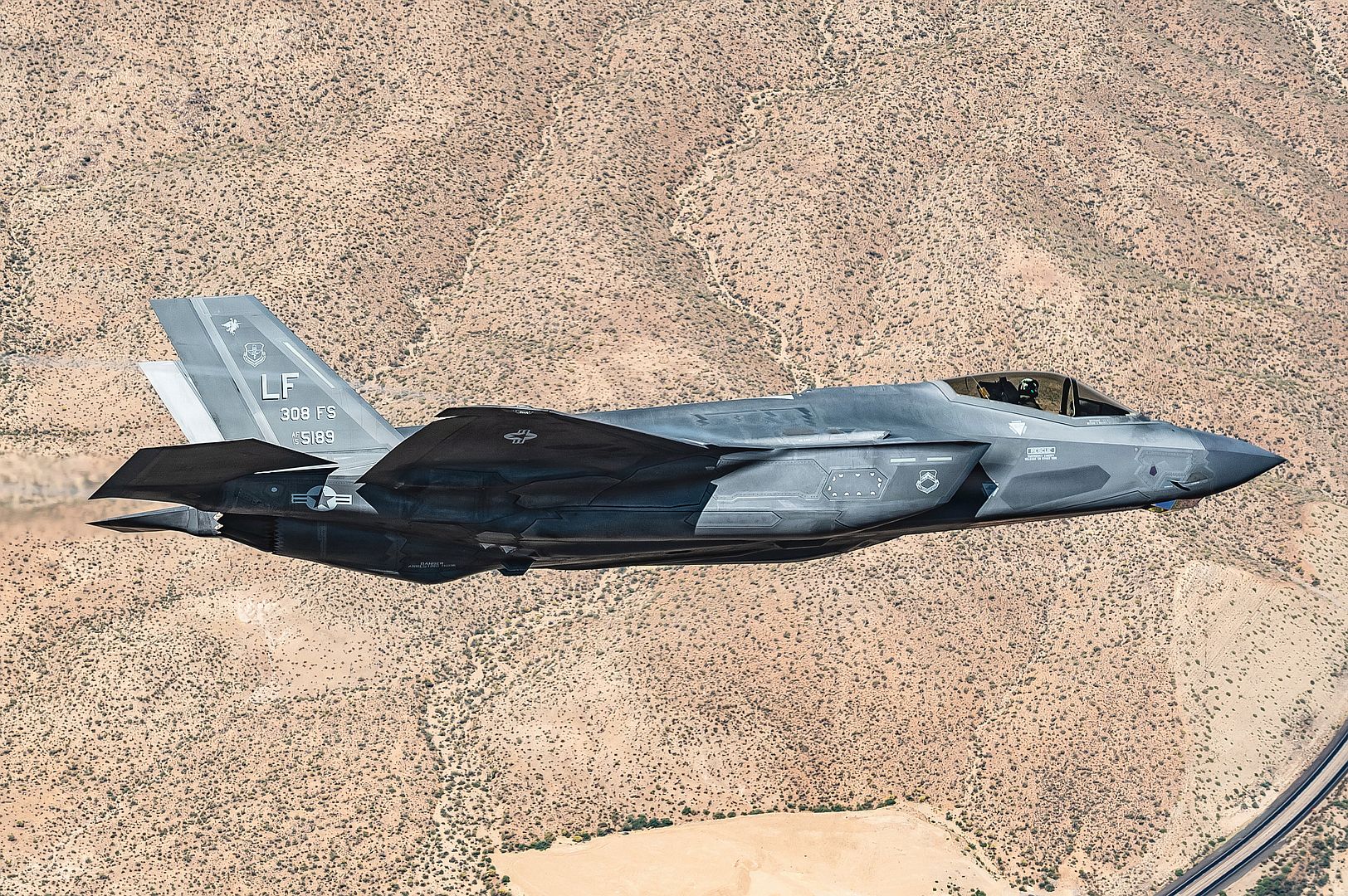
GREENVILLE, S.C., April 23, 2026 /PRNewswire/ -- Lockheed Martin (NYSE: LMT) welcomes the Government of Peru's announcement to purchase 12 new F-16 Block 70 aircraft to modernize the nation's fighter fleet and strengthen its national defense capabilities.
The F-16 will provide Peru with a proven, highly capable and interoperable multirole fighter aircraft that enhances air sovereignty, supports regional security and enables long-term operational readiness. The Block 70 is the newest and most capable F-16 ever built with the longest service life, lowest lifecycle cost, and strongest global support base of any fighter in production today. It features advanced technology, radar, and weapons systems that give pilots better awareness and greater protection to achieve their mission and return home safe.
"Peru's choice of the F-16 underscores the aircraft's unmatched operational performance and combat record, as well as its ability to meet the most pressing defense requirements," said Mike Shoemaker, Vice President of Integrated Fighter Group at Lockheed Martin. "We are proud that the most advanced F-16 ever produced will help protect Peru's national sovereignty while strengthening the enduring partnership between our nations."
The acquisition marks a major step in the Peruvian Air Force's fighter fleet transformation, reinforces a longstanding strategic partnership with the United States, and enables industrial collaboration opportunities.
"Cooperation between U.S. and allied defense industrial bases has always been a shared source of security and economic benefit," added Shoemaker. "These ties will continue to strengthen with Peru through the F-16 Block 70 program, fostering economic growth for all partners."
With the selection of the F-16, Peru joins 29 other nations and a global fleet of more than 2,800 F-16s operating today. Peru's fleet of F-16s will be produced at Lockheed Martin's facility in Greenville, South Carolina.
FRIEDRICHSHAFEN, Germany (April 23, 2026) — Textron Aviation Inc., a Textron Inc. (NYSE:TXT) company, today announced that Turkish Airlines Flight Academy has signed a purchase agreement for 10 Cessna Skyhawk aircraft, expanding its training fleet to support growing airline pilot demand across Europe. Turkish Airlines Flight Academy currently operates 66 Cessna Skyhawk aircraft, making it one of the largest Skyhawk training fleets in the region. Deliveries of the new aircraft are expected to begin this year.
“The Cessna Skyhawk continues to set the standard for flight training worldwide, offering the reliability, performance and operating efficiency flight schools depend on,” said Lannie O’Bannion, senior vice president, Sales & Marketing. “This order reflects Turkish Airlines Flight Academy’s confidence in the Skyhawk as it continues to scale its training capacity to meet long‑term pilot demand.”
Founded in 2013, Turkish Airlines Flight Academy is based in Aydin, Turkey, and operates as a wholly owned flight training organization of Turkish Airlines. The academy trains pilots for Turkish Airlines and other regional carriers, playing a critical role in developing a long‑term commercial pilot pipeline.
To meet increasing training requirements, Turkish Airlines Flight Academy has steadily expanded its Skyhawk fleet, taking delivery of 51 aircraft during the past five years. The additional aircraft will further standardize its training operations while reinforcing Textron Aviation’s leadership in the global flight training market.
About the Cessna Skyhawk
The Cessna Skyhawk is considered the aircraft of choice for pilot training, and it is the most popular single-engine aircraft in aviation history. Since the aircraft first took flight in 1955, over 45,000 Skyhawks have been delivered to customers around the world — more than any other aircraft in the industry. The single-engine four-seat, high-wing Skyhawk is renowned for offering the best combination of modern features, including the Garmin G1000 NXi avionics with wireless connectivity, a standard angle-of-attack display system, and proven dependability. The aircraft also features a McCauley aluminum fixed pitch propeller.