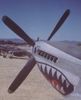
North American FJ-4 Fury
-
The last of the naval Furies was the FJ-4. Some people argue that the FJ-4 was the best version of the entire F-86 Sabre/FJ Fury series. The FJ-4 at first glance appears to be a modified F-86 Sabre that had first flown back in 1947. However, when one looks closer, it has many differences and only the family ancestry is apparent.
The FJ-4 began its life in June 1953 as company project NA-208 which called for two prototypes and as company project NA-209 which was the production version. The Navy wanted a maximum speed of Mach 0.95 and a combat altitude of 49,000 feet, requirements never before having been met without using an afterburning engine.
On October 16, the Navy issued a contract for 132 examples under the designation FJ-4. On June 26, 1954, the Navy added 45 more FJ-4s. Serials were 139279 and 139280 for the NA-208 prototypes, and 139281/139323 and 139424/139530 for the NA-209 production run.
The FJ-4 differed from the FJ-3 in that it could carry 50 percent more internal fuel. To accommodate the extra fuel, an extra tank was added underneath the engine, which required that the airframe be redesigned. A dorsal spine was added that began at the rear of the canopy and extended all the way the tail which provided the FJ-4 with a "turtledeck" appearance reminiscent of the F-84F Thunderstreak.
A thinner "wet" wing with a larger area of 338.66 square feet was used. The wing was reduced to a thickness/chord ratio of six percent. The wing span was increased by two feet and the inboard chord length was increased while maintaining the 35-degree leading edge sweepback. The wing skins were milled from solid aluminum plate. Other wing features included a four-degree washout at the wingtip, mid-span trailing-edge aileron surfaces (all earlier Sabres and Furies had their control surfaces on the outer wing), and inboard high-lift trailing-edge flaps. The wings folded at a point immediately outboard of the ailerons.
The FJ-4 also differed from earlier Furies in incorporating a drooping wing leading edge. The earlier Furies and Sabres used leading-edge slats that were aerodynamically actuated. The leading edge droops provided additional lift during landing and improved low-speed handling. The drooping leading edges were mechanically linked to the trailing edge flaps and could only be extended when these flaps went down.
The tail surfaces were also almost completely new. The horizontal tail surfaces of the FJ-4 had no dihedral and had a smaller span and a larger chord than on previous Furies. The were also much thinner and had mid-span control surfaces that did not extend all the way to the tip. The tail was the all all-flying variety and moved as a unit, with the elevators being mechanically linked so that they moved in conjunction with the stabilizer to provide better high-speed controllability
The vertical tail of the FJ-4 was taller than that of the earlier Fury models. It also differed from earlier Furies in having a fuel overflow vent which protruded from the rear of the surface about mid-height. This fuel overflow vent was only used to prevent overfilling and should not be confused with the fuel dump nozzles in the wingtips. The ribbed rudder was located below the fuel vent, in contrast with that of earlier Furies, which had the rudder extending nearly all the way to the tip.
The landing gear was also entirely new, being levered and having the track increased from 9 feet to 11 feet 7 inches. The undercarriage was also redesigned so that upon retraction it would leave enough space for an acceptable wing box.
FJ-4s BuNo 139303 and beyond were equipped with a inflight refuelling probe permanently mounted underneath the port wing.
The primary armament was four 20-mm cannon mounted in the fuselage sides just aft of the nose air intake. FJ-4s could also carry up to four AIM-9 Sidewinder air-to-air missiles on underwing hardpoints. The FJ-4 was equipped with a radar-ranging gunsight in the upper nose, which was used to calculate the lead angle for firing the guns during air-to-air gunnery. The FJ-4 was intended to operate primarily as an air-to-air fighter, but had a limited ground-attack capability. They could carry some bombs and rockets plus the 20mm cannon could be used for strafing.
The first FJ-4 (139279) took off on its maiden flight on October 28, 1954, flown by test pilot Richard Wenzell. It was powered by a 7650 lb.s.t. Wright J65-W-4 engine, the same engine that powered the FJ-3. For some reason, the two prototypes built on the NA-208 contract were designated FJ-4, not XFJ-4.
Production FJ-4s (NA-209 contract) began to appear in February 1955. These were powered by the Wright J65-W-16A that offered 7700 pounds of thrust. The FJ-4 carried additional armor in the nose, space was provided by reducing the ammunition capacity to 576 rounds of 20-mm shells.
Seventeen FJ-4s were completed in 1955, followed by 113 in 1956. The first squadron to use the FJ-4 was Marine Squadron VMF-451. By March of 1957, all 152 aircraft on the first contract had been delivered. All of these aircraft went to just three Marine Fighter Squadrons: VMF-232, VMF-235, and of course VMF-451. The only Navy squadron to use the FJ-4 was VA-126, the Replacement Air Group (RAG) squadron that later trained Navy FJ-4B pilots at NAS Miramar.
FJ-4B
The FJ-4B was a ground attack version of the FJ-4, and was in fact built in larger numbers than the original FJ-4. It was similar in concept to the F-86H Sabre, although there was no direct relationship between the two aircraft other than their common ancestry.
The FJ-4B differed from the FJ-4 by being strengthened to take six underwing ordinance stations capable of carrying a total of up to 6000 pounds of fuel tanks, rockets, or bombs. It could carry up to four underwing drop tanks (2 150-gallon and/or 2 200 gallon tanks).
The FJ-4B was equipped with a set of flight spoilers situated just ahead of the trailing-edge flaps, which were used at low altitudes and high Mach numbers to improve the controllability.
The FJ-4B was also fitted with an additional pair of speed brakes underneath the fuselage near the tail. These brakes were linked to the main speed brakes on the fuselage sides just aft of the wing trailing edge and could be used to reduce speed during low-level bombing attacks. However, the primary purpose of these additional brakes was to reduce carrier landing speeds and to give the aircraft better go-around capabilities in case of a bolter. The brakes made it possible to use a higher engine RPM during landings, avoiding a regime in which the engine ran roughly. Just before landing, these additional brakes were automatically closed when the undercarriage was lowered to prevent the brakes from scraping on the deck during landings. All four of the speed brakes were activated by a single switch on the throttle lever.
The FJ-4B was equipped with the Low Altitude Bombing System (LABS), and was capable of carrying a nuclear weapon on the left middle wing station (#2). When the LABS was installed, the radar ranging gunsight was removed.
All FJ-4Bs had an inflight refuelling probe permanently installed underneath the port wing, just inboard of the wing fold. This could be used to refuel via the "probe-and-drogue" technique. It was possible to refuel all of the tanks (including the underwing drop tanks by this technique.
Twenty-five FJ-4Bs had been added onto the original Navy NA-209 contract on July 26, 1954, and the first example flew on December 4, 1956. Serials were 139531/139555. Forty-six more FJ-4Bs were ordered under contract NA-229 on November 2, 1954. Serials were 141444 thru 141489. The last one was completed in August of 1957.
During service, some FJ-4Bs had the port pair of 20-mm cannon removed so that a standby generator system could be installed. This standby generator provided power backup in case the main generator failed--without the backup it was nearly impossible to fly at night or under instrument conditions for more than a few minutes with only battery power. At the same time, the standard ejection seat was replaced by a Martin-Baker seat that provided the ability to eject safely at much lower altitudes.
Demand for the ground-attack Fury was such that Contract NA-244 was placed on April 5, 1956 calling for an additional 184 FJ-4Bs, but this was latter cut back to 151 aircraft. Serials were 143493 to 143643. These were delivered between July 1957 and May 1958.
The last FJ-4B was delivered in May of 1958, bringing the total to 222.
The FJ-4B was equipped to deliver the Martin ASM-N-7 Bullpup air-to-surface guided missile. The Bullpup was an eleven-foot long missile driven by an Aerojet General solid rocket motor. Total weight of the missile was 571 pounds and it was equipped with a 250-pound high explosive warhead. Maximum speed of the Bullpup was about Mach 1.7 and its effective range was in excess of four miles. Up to five Bullpups could be carried underwing on the FJ-4B, with the starboard inner station (#4) carrying a guidance transmitter pod. The Bullpup was redesignated AGM-12B in 1962.
The Bullpup was usually fired from a shallow dive, with the pilot putting his gunsight pipper on the intended target. After launch, the Bullpup was guided to its target by the FJ-4B pilot by operating a miniature control stick. A flare in the missile's tail made the missile visible to the pilot and the guidance was done by sending radio control signals to the missile to move the fins on the rocket. The original concept of the Bullpup was to provide a highly accurate weapon that allowed the aircraft to remain at a longer, safer distance away from the target to avoid enemy ground fire.
The FJ-4B served with Naval Attack Squadrons VA-55, VA-56, VA-63, VA-116 (VA-144), VA-126, VA-146, VA-151, VA-192 (VA-216), VA-212, VA-214 and with Marine Attack Squadrons VMA-212, VMA-214, and VMA-223, all with the Pacific Fleet. VA-126 was the Replacement Air Group (RAG) for the FJ-4 and was based at NAS Miramar.
The FJ-4B's first operational cruise was onboard the USS Hornet with VA-214. Its final operational cruise with the Navy took place with VA-216 aboard the USS Hancock in 1962. After that time, surviving FJ-4s and FJ-4Bs were transferred to reserve units. The FJ-4 Fury was destined never to fire a shot in anger.
On October 1, 1962, the US Defense Department adopted a uniform designation system for both Navy and USAF aircraft. Under this system, the FJ-4 Fury was redesignated F-1E and the FJ-4B as AF-1E. By this time, the F-1Es and AF-1Es no longer served with operational Navy or Marine squadrons, all of the survivors having been transferred to reserve units. AF-1E Furies remained with the Naval Air Reserves until the mid 1960s until they were finally withdrawn.
FJ-4B 143575 was operated for a time under the civilian registry of N400FS (later N9255) by Flight Systems International of Mojave, California on various military contract duties.
Serials of FJ-4 Fury:
139279/139280 North American FJ-4 Fury
139281/139323 North American FJ-4 Fury
139424/139530 North American FJ-4 Fury
139531/139555 North American FJ-4B Fury
141444/141489 North American FJ-4B Fury
143493/143643 North American FJ-4B Fury
Below FJ-4 Fury is spotted on a catapult aboard the aircraft carrier USS Forrestal (CVA-59) during carrier qualification trials, April 1956.
Below North American Fury FJ-4 139300
Below North American FJ-4 Fury (BuNo 139290) from Utility Squadron VU-7 Redtails on the ground at Naval Auxiliary Air Station Brown Field, California (USA), in 1960.
Below FJ-4 Fury of U.S. Marine Corps fighter squadron VMF-232 Red Devils at MCAS Kaneohe Bay, Hawaii (USA), in 1958.
Below FJ-4 Fury assigned to Utility Squadron (VU) 7 pictured in March 1960. VU-7 supported the operation of target drones.
Below J-4 Fury assigned to Guided Missile Group One pictured on the flight deck of an unidentified carrier.
Below FJ-4 Fury aircraft assigned to Marine Fighter Squadron (VMF) 323 pictured in formation during flight out of MCAS El Toro, CA, circa 1959.
Below FJ-4 Fury assigned to Marine Fighter Squadron (VMF) 232 pictured on the ground, circa 1959.
Below North American Fury FJ-4B 1339552.
Below North American Fury FJ-4B with MK-105 BuNo 139541. Assigned NASWF Albuquerque, NM. Shown at China Lake NAS 28 Feb 1958.
Below North American Fury FJ-4B 139541, US Navy photo
Below North American Fury FJ-4B 143569
Below North American Fury FJ-4B 143562
Below North American Fury FJ-4B 141478
Below North American Fury FJ-4B 141473 July 1958 on USS Lexington
Below North American Fury FJ-4B 141456
Below North American FJ-4B, 143504
Below North American FJ-4B Fury from Attack Squadron VA-146 Blacktails in flight over Naval Air Station North Island, California
Below FJ-4B Fury from Attack Squadron VA-146 Blue Diamonds taking the barrier aboard the aircraft carrier USS Oriskany (CVA-34) on 21 November 1960.
Below FJ-4B Fury aircraft (BuNo 143636) of Marine Attack Squadron VMA-214 Black Sheep pulls up to be refueled by a U.S. Air Force Boeing KB-50J Superfortress.
Below FJ-4B Fury (BuNo 143603) from Attack Squadron VA-126, circa 1960.
Below FJ-4B Fury (BuNo 139553, 143608, 143609, 143611) of Attack Squadron 126 (VA-126) Bandits in flight near Naval Air Station Miramar, California (USA), on 19 November 1958.
Below FJ-4B 143585 of VMA-212 on board the USS Oriskany (CVA-34)
Below FJ-4B 143510
Below FJ-4B 139547
Below AJ-2 Savage (BuNo 134044) of Heavy Attack Squadron VAH-6 Fleurs refueling a U.S. Marine Corps North American FJ-4B Fury of Marine Attack Squadron VMA-223 Bulldogs while flying over Catalina Island, California (USA)
Below FJ-4B Fury of Attack Squadron (VA) 146 in flight.
Below FJ-4B Fury aircraft from Attack Squadron 214 (VA-214) Volunteers in flight over Naval Air Station Barbers Point, Hawaii (USA), on 26 January 1958.
Another Fury development was the FJ-4F which appeared in April of 1957. It began its life in August of 1955 as company project NA-234, and eventually evolved into project NA-248. This project involved the mounting of a 5000 pound thrust Rocketdyne AR-1 rocket engine over the tailpipe of the second and fourth production FJ-4s (139282 and 139284). The AR-1 rocket motor was fueled by a mixture of hydrogen peroxide and JP-4. The FJ-4F aircraft were flown both with and without a specially instrumented nose cone. Sometimes, a supplementary flush-mounted ventral fuel tank was also fitted. Although the performance of the FJ-4F was impressive, the project was not pursued any further.
Below FJ-4F Fury (NA-248, BuNo 139284).

Below FJ-4F Fury (NA-248, BuNo 139282) retired at NAF Litchfield Park, Arizona (USA), in 1960.
Specifications (FJ-4)
General characteristics
Crew: 1
Length: 36 ft 4 in (11.1 m)
Wingspan: 39 ft 1 in (11.9 m)
Height: 13 ft 11 in (4.2 m)
Wing area: 338.66 sq ft (31.46 m2)
Empty weight: 13,210 lb (6,000 kg)
Gross weight: 20,130 lb (9,200 kg)
Max takeoff weight: 23,700 lb (10,750 kg)
Powerplant: 1 × Wright J65-W-16A turbojet, 7,700 lbf (34 kN) thrust
Performance
Maximum speed: 680 mph (1,094 km/h, 590 kn) at sea level
Range: 2,020 mi (3,250 km, 1,760 nmi) with 2× 200 gal (760 L) drop tanks and 2× AIM-9 missiles
Service ceiling: 46,800 ft (14,300 m)
Rate of climb: 7,660 ft/min (38.9 m/s)
Wing loading: 69.9 lb/sq ft (341.7 kg/m2)
Armament
Guns: 4 × 20 mm (0.787 in) Colt Mk 12 cannon (144 rpg, 576 rounds in total)
Rockets: 4 × (6 x FJ-4B) 70mm rocket pods, 4x LAU-10 Zuni rocket pods
Missiles: 4 × AIM-9 Sidewinder missiles (6 x AIM-9 Sidewinder FJ-4B), 5x AGM-12 Bullpup + Control pod (FJ-4B)
Bombs: up to 3,000 lb (1,400 kg) of underwing ordnance
North American FJ-1 Fury link --- http://axis-and-allies-paintworks.com/e107_plugins/forum/forum_viewtopic.php?p=1&id=2902#post-2902
North American FJ-2/3 Fury link --- http://axis-and-allies-paintworks.com/e107_plugins/forum/forum_viewtopic.php?p=1&id=350#post-350